
This webpage will keep Jupiter Bay unit owners informed on progress to stop and repurpose the Association's $6.86 million Concrete Restoration Project.
If you haven't already signed up for our bulletins that will keep you informed regarding our efforts, you can subscribe to these bulletins via the following link: Subscription Form.
Marcon Engineering Peer Evaluation Results
The Jupiter Bay Concerned Owners Committee (COC) hired a forensic engineering firm, Marcon Forensics LLC, to conduct a peer evaluation of the Association’s $7.0+ million Concrete Restoration Project currently underway. The entire report can be accessed through the link at the bottom of this article.
The Association resisted this peer review by preventing Marcon from communicating with the Property Manager and the project’s engineering firm, Swaysland. The Association’s attorney sent both the COC’s attorney and Marcon a letter saying that “the Association rejects your request for a second engineering opinion”. On July 15 the Association attorney told Marcon that “unit owners do not have the authority to retain experts to evaluate or opine on common elements or limited common elements.”
Despite these obstacles and limited access to the construction site, the review was conducted using available engineering inspection documents, contractor bid documents, payment application requests, attorney letters, and visits to owner units. Visual onsite inspections of units and common areas including those under construction were performed.
Marcon’s Observations and Analysis
- Unit C404W, referenced by the Association on various occasions, appeared to have clean rebar and sound concrete in the area adjacent to the sliding glass doors, refuting the Association’s assertion.
- Variances were observed between the contractor’s bid quantities and inspection report quantities, potentially resulting in change orders, delays, and funding issues.
- Phase 2 Milestone Inspection reports were completed months after the inspections once the COC’s attorney drew attention to these missing documents needed to justify the Association’s claims of “substantial structural deterioration”.
- As of June 2025, change orders already amounted to over $54,000 for “additional quantity/scope” indicating that further change orders are likely.
- Various units rated as having “moderate” or “severe” concrete damage in the 2020 inspection reports were rated as “no damage” in the 2024 inspection reports without information as to whether they were repaired over this period or why the inspections showed different results.
- In the Phase 1 Milestone Inspection Reports, most conditions for structural systems are identified as “Good”. The Inspection Form defines Good as “No Substantial Structural Deterioration and No Dangerous Condition Observed.” However, in multiple follow-up instances, Swaysland claimed that repairs are required because of Substantial Structural Deterioration.
Marcon’s Conclusions and Recommendations
- Concrete repairs are necessary, but the proposed scope exceeds mandatory requirements for the Milestone Inspection Program.
- Quantities mentioned in the schedule of values will not be sufficient to capture the full scope of work and will result in change orders and additional costs throughout the project.
- To minimize cost “value engineering” should be considered in addressing repairs. Value engineering would limit the project to those units with the most damage and repairs to the ones which deliver the most value for the cost incurred.
- Prior to future project phases, bid quantities should be reevaluated based on actual repairs to prevent financial strain from future change orders.
- A phased project approach would be more feasible, limiting repairs to areas of immediate concern as identified by the concrete inspection reports and utilizing SIRS funds to provide continuous future maintenance. The milestone reports reaffirm the Association’s favorable record of maintaining and performing concrete repair throughout the history of the buildings based on this approach. It reduces the unnecessary financial impact on unit owners.
- Overall, transparency and communication among all parties involved are lacking but are essential for effective project management and community trust.
In conclusion, all units did not need repairs, and huge special assessments weren’t necessary. Special assessments should only be used for mandatory projects (new roofs, underfunded insurance, budget shortfalls, etc.) and not for ongoing concrete repairs that can be addressed largely through SIRS reserve contributions.
| Click on the following link to obtain a copy of Marcon's Peer Evaluation of the Association's Concrete Remediation Project. | Marcon Peer Evaluation Report |
Association's Response to Owner's 2nd Attorney Letter
On June 19th, we received an email from the Association's attorney responding to our June 2nd attorney email. The Association's email contained many inaccuracies including the following false statements:
- Concerned Owners lack of understanding of concrete deterioration.
- The need to "repair" balconies with little or no concrete deterioration.
- The cause of alleged holes under the tile in unit C402.
- Claiming that repaired balconies won't need further repair work for another 15-20 years.
- A second engineering opinion would be redundant.
- A community-wide $7.0 million concrete restoration is the best course of action.
- Unlicensed contractors without engineering supervision were used previously at Jupiter Bay.
- Engineers that do quality engineering work will always provide the best recommendations without considering their future income.
Attached is a copy of The Association attorney's June 19th letter with our responses (in red): 6/19 Association Attorney Letter.
Owners' 2nd Attorney Letter
Over 40 Jupiter Bay unit owners have engaged the services of Lippes Mathias Attorneys at Law and attorney Michael Posner to issue a stop-work injunction for the $6.86 million Concrete Restoration Project. Our goal is to encourage the Association's Board of Directors to renegotiate and significantly reduce the contract with Custom Group to address repair of just those unit balconies with "serious" or "moderate" concrete damage.
Renegotiating this contract would allow it to be mostly funded through existing or future reserves instead of huge owner special assessments of up to $25,000.
The following letter was sent on June 2, 2025, to the Jupiter Bay Condo Association's attorney by the Homeowner's attorney: Second Attorney Letter.
A Department of Business & Professional Regulation, Division of Condominiums, Timeshares, and Mobile Homes Complaint was issued against the Association on 5/26/25 and was referenced by and attached to the Attorney's letter. You can view the Complaint here: DBPR Complaint.
Please review these documents and contact the Association's Board Members to express your concerns regarding their inappropriate actions in approving an unnecessary $6.86 million unfunded Concrete Restoration Project.
Thank You,
Concerned Jupiter Bay Owners
Phase One Milestone Inspection Reports
Phase one Milestone Inspections conducted in 2024 showed all nine (9) buildings three stories and above to be reasonably structurally safe. Specifically, every building report stated that:
Summary
- The building is reasonably structurally safe for continued occupancy; however, there are concrete repairs that are required. Repairs are required at isolated areas of concrete deterioration of the building structure which includes the balcony slabs, walkway slabs, building walls and columns. The deterioration is a result of corrosion of the embedded reinforcing bars.
- No deficiencies with windows, roof structure, masonry walls, wood and structural steel were observed that would require immediate repair.
- Besides required repairs, we recommend that:
- Any remaining original windows or doors be replaced with new impact windows or doors that would have higher wind load and water intrusion ratings than the originals.
- All screen enclosures be replaced with new ones.
Present Condition
- No bulging, settlement, deflections, expansions or contractions.
- Concrete/stucco deterioration in the form of cracking/spalling at the balcony and public walkway slabs and exterior columns.
- The exterior finishes are generally in good condition with localized stucco delamination and stucco cracking.
- Hairline cracks were observed at balcony slabs, public walkway slabs and stucco finish. Fine to medium cracks were observed at building columns due to concrete spalling.
- Deterioration is present in the form of cracked and spalled concrete at the exterior building slabs and columns and cracked and delaminated stucco finish.
- No signs of differential settlement or other foundation problem was observed.
Masonry Bearing Wall
- Exterior masonry finishes are good.
- Interior masonry finishes are good.
- Cracks: Hairline cracks present in stucco finish.
- Spalling: None.
- No visible rebar corrosion.
Floor & Roof System
- The roof slab is a conventionally reinforced flat concrete slab in good condition where observed.
- The elevated slabs are conventionally reinforced concrete slabs, supported by conventionally reinforced columns.
- The ground floor is a concrete slab on grade. The condition was good where observed except for the deterioration previously noted.
- Waterproofing finishes were added after construction.
Concrete Framing
- The concrete framing system is generally in good condition, with localized concrete cracking and spalling at private balcony and public walkway slabs.
- Cracking due to corroding reinforcing bars was observed at building slabs & columns.
- Rebar corrosion is significant – Structural concrete repairs to slabs and columns are necessary to restore to pre-damaged condition.
Windows
- Original windows are in poor condition.
- Replacement windows are in fair to good condition.
Wood Framing
- Truss plates were observed to be in good condition.
- Joints were observed to be in good condition.
Phase Two Inspection Report Analysis
Phase Two Inspection Report Dates
On May 29, 2025, the Association, after receiving our 5/16/25 Attorney Letter, alleges that they miraculously found nine (9) phase two inspection reports, and that these reports:
- Were created when the phase one inspections were performed,
- Appear to contradict the Phase one findings, and
- Show all East and West buildings (excluding East C) to have "substantial structural deterioration" and are considered dangerous.
Here's a list of the phase two reports:
| Association/Building | Phase Two Inspection* | Report Signed |
| East A | 4/15/24 – 4/26/24 | 5/29/25 |
| East B | 4/15/24 – 4/26/24 | 5/29/25 |
| East C | None Conducted** | |
| East D | 7/15-24 – 7/31/24 | 5/29/25 |
| West A | 6/13/24 – 7/9/24 | 5/29/25 |
| West B | 7/18/24 – 7/31/24 | 5/29/25 |
| West C | 7/11/24 – 7/31/24 | 5/29/25 |
| West D | 7/16/24 – 7/31/24 | 5/29/25 |
| West E | 2/8/24 – 5/20/24 | 5/29/25 |
| West F | 2/8/24 – 5/20/24 | 5/29/25 |
* Same dates as Phase one inspections.
** Concrete restoration work was done on all units of East C without a Phase two inspection.
Report on Findings (From Phase two reports)
- The building has Substantial Structural Deterioration or is considered dangerous; Corrective Action is Required. (#10)
- No unsafe or dangerous conditions exist. (#7).
- The building doesn’t need to be vacated at this time. Once the repair project starts, access will be restricted at the work areas. (#9)
- All private balconies and public walkways have been inspected by visual observation and acoustic emission (tap sound). Exterior columns were inspected by visual observation from the balconies, walkways and ground. (#4)
- Repairs are required at the public walkways, private balconies and exterior walls and columns. (#2)
- The damage is cracking and spalling of conventionally reinforced concrete exterior slabs and columns. The extent of the damage is localized areas. Standard structural concrete repairs should be performed as soon as practical. (#3)
- No additional inspections are required. (#8)
- No additions to original structure observed. (#1n)
- The project will be performed in three (3) phases with an expected project duration of 30 months. (#6)
Problems with the Report
- Unit owners were not told for a year that their buildings had “Substantial Structural deterioration” and are considered dangerous (or are they, based on report contradiction?).
- No unit balconies that had a Phase two inspection were identified. Shouldn’t the Phase two report say specifically what was done and where additional inspections/testing was performed (what balconies or walkways needed a Phase two?).
- Upon completion of a phase one or phase two inspection of each building, a detailed inspection report, with a separate summary, is to be sent to the Condominium Association and local enforcement agency. The summary must contain, at least, the material findings and recommendations. We don’t believe that this was done for Phase two.
- Within 45 days after receiving each inspection report, the Association must distribute a copy of the inspector-prepared summary of the inspection report to each condominium unit owner, regardless of the findings or recommendations in the report, by United States mail or personal delivery, should have posted a copy of the inspector-prepared summary in a conspicuous place on the condominium property, and should have published the full report and inspector-prepared summary on the Association’s website. This was not done for Phase two..
- It is a breach of a board member or officer’s fiduciary duty if an association fails to complete the required Phase one, and if required, Phase two Milestone Inspections.
- Unsafe building & balcony conditions must be disclosed to potential purchasers and renters. Acknowledging unsafe building conditions can impact condo sale prices, insurance premiums, and ability to rent a unit. Pending Special Assessments must be disclosed at the time of sale.
Complaint Against Swaysland Engineering (Not Filed)
The following Florida Board of Professional Engineers complaint was written on 4/29/25 against Swaysland Professional Engineering, license #PE29241/SI1055. Upon attorney advice the complaint was never filed:
Please give full details of your complaint. Include facts, details, and dates. Please attach copies of documents, records, correspondence, plans and contracts.
| The Jupiter Bay Condominium Association used Swaysland Professional Engineering Consultants to perform Milestone Inspections of its 9 buildings that are three stories or higher. All Phase One inspections were completed by 7/31/24.
The Phase One Milestone Inspection Reports for all 9 buildings stated "The building is reasonably structurally safe for continued occupancy; however, there are concrete repairs that are required. Repairs are required at isolated areas of concrete deterioration of the building structure which includes the balcony slabs, walkway slabs, building walls and columns.” No phase Two repairs were recommended, completed, or reported at the time of these inspections. Regardless, Swaysland's V-P of Engineering said "Per the new milestone requirements, you are mandated to make repairs of substantial structural damage. We consider the concrete spalling located at the building to be substantial structural damage per its’ definition. So minimally, all the concrete spalling located at the building needs to be fixed. That would include even spalls on minor units.” As a result of Swaysland's direction, one major concrete restoration project was completed and a second is underway. They are: 1) East C Building Concrete Remediation in 2024 and 2) Site-wide Concrete Remediation in 2025. Attached is detail regarding these projects. The attached shows that Swaysland has, on multiple occasions, exaggerated the seriousness of concrete damage of Jupiter Bay’s buildings and has utilized the new inspection requirements to claim that these concrete remediation projects are mandated by Florida statute resulting in over $7.0 million expenditure for concrete restoration projects. Click on the following link to obtain complaint details: Engineering Complaint |
Forensic Engineer Hired for Concrete Project Peer Review
A group of Jupiter Bay homeowners concerned with the magnitude and scope of the Association’s Concrete Restoration Project has made progress in disclosing information on the project. However, homeowner efforts are being thwarted by the Board and the Association’s attorney who is being directed by the Board.
A forensic engineer with Marcon Forensics LLC was hired by homeowners to do a peer review of the Association’s Concrete Project, and he has been provided information regarding Swaysland Engineering’s inspections. Marcon’s engineer has contacted Swaysland and was told that the Association is not permitting them to meet with him to discuss the project. The Marcon engineer has requested internal project documents used for the project’s bidding/permitting but is not expecting a favorable response.
On July 15, Marcon received an attorney letter from the Association (paid for by your fees) acknowledging Marcon’s requested meeting with Swaysland. The Association attorney’s response was as follows:
“Your clients' engagement of their own engineer to perform an analysis similar to the one that Swaysland Professional Engineering performed is not only irrelevant but will simply result in another estimate of anticipated quantities of concrete that require repair, which will not truly be known until the work is commenced. Therefore, the Association rejects your request for a peer review. Further, the Association will not continue to engage in a correspondence exchange relevant to the need for the project and has instructed its EOR [engineer of record] to do the same.”
Apparently, the Association has no interest in obtaining a second opinion for verifying its $6.86 million expenditure. It also presumably believes that Swaysland’s Milestone inspections are mostly irrelevant since the amount of concrete repair will not be truly known until all balconies are revisited and “repaired”.
In the letter to Marcon, the Association’s attorney also erroneously said that all the common and limited-common (i.e., balconies) elements “are the property of the Association and not of any individual unit owner.” The attorney doesn’t understand the concept of condominium ownership. The facts are that these elements are owned by the Association members. According to Florida statute 718: “Condominium means that form of ownership of real property, which is comprised entirely of units that may be owned by one or more persons, and in which there is, appurtenant to each unit, an undivided share in the common elements.”
In other words, the unit owners, not the Association, own the common elements and balconies. We each own 1/359th share of the property. The Association, who is responsible for maintaining our units, owns no real property. We have exclusive right to use our balconies to the exclusion of other units. We expect Board members to exercise their fiduciary responsibility by performing only necessary maintenance and repair of our property.
Association members were misled by Swaysland Engineering and the Board. We were told that the Concrete Remediation Project was mandated by Florida law resulting from Milestone Inspections that revealed substantial structural deterioration in all our three stories and above buildings. Marcon is proving that this is untrue. There is some concrete damage within our unit balconies and walkways but not of the magnitude suggested by the Board. This damage and only this damage needs to be addressed with increased transparency to unit owners.
B305 & A207 West Concrete Damage Mystery
On July 19, 2025, the Association's V-P posted a Newsletter regarding the concrete repair work being done on B305 West. The newsletter described the owner's surprise at the extent of the remediation needed on his condo. The owner said that 2 feet of the leading edge of the balcony's concrete had to be removed and that the rebar below the sliding glass doors was affected, requiring removal of the doors.
On July 24, 2025, the Association's Property Manager sent out a Concrete Remediation Update with pictures showing the significant concrete damage found in A207 West's balcony.
A review of the concrete inspections and West building repairs provided the following information regarding these units:
- Swaysland’s 2020 Balcony Concrete Repair Investigation reported that on 9/23/20, Unit B305 West had “moderate” concrete damage in all three balconies (living room, dining room, & bedroom), and A207 had "moderate" concrete damage in its living room balcony. The following damage was reported:
- Deck Spall at bottom surface of slab (A207)
- Crack and/or spall at slab edge (B305 living room),
- Crack and/or spall at building column or wall (B305 living room),
- Cracked and/or delaminated stucco (both A207 & B305), and
- Delaminated tiles (both A207 & B305).
- In the years (2021-2024) since the 2020 Concrete Investigation, $89,487 was spent on West A concrete remediation and $141,465 was spend on West B concrete remediation, depleting much of the buildings' reserves.
- Both units (B305 & A207 West) were inspected by Swaysland again on 8/28/24. This inspection reported that both units had “no damage” in any of their balconies, although they did have some delaminated tiles.
I don’t understand these Association Newsletters. If B305 and A207 West’s concrete condition “improved” from 2020 to 2024 as the Swaysland inspections reported,
- How could they be so bad in 2025?
- Were they repaired after the 2020 inspection? If so, were the repairs done improperly?
- Did Swaysland do poor inspections in 2024 and completely miss the presumably major concrete damage of these units found less than a year later?
These newsletters leave us with more questions than answers.
What's Wrong with this Picture?
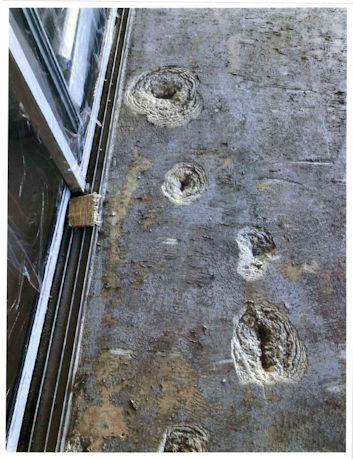 According to Swaysland's engineer, "The typical method for concrete deterioration is caused by corroding reinforcing bars exerting an internal pressure on the concrete, eventually resulting in cracking and spalling at the concrete surface. The steel corrosion is caused by chloride ions in the atmosphere attacking the reinforcing bars. The chloride ions are carried by rainwater to the reinforcing bars through cracks and voids in the concrete surface. Concrete naturally has a protection layer when it is originally cast. Over a period of time, the natural protection is lessened, and the chloride content increases, and, eventually, the corrosion process starts. This typically takes twenty (20) to thirty (30) years and will continue for the building’s life span."
In his June 19th email, the Association's attorney attached this picture saying that “enclosed is a photograph of a balcony in the C West Building where there is visual evidence of concrete erosion on the balcony.” He indicated that this damaged concrete was hidden under the balcony tiles.
Property Manager Chris Sands also showed these pictures in his project update as evidence that the concrete deterioration was much more severe than indicated in the inspections which categorized this damage as “moderate”.
Here are some facts regarding the damage depicted in the pictures:
- As the Swaysland engineer says: "Rebar corrosion results in cracking of the concrete surface (not holes)."
- Concrete does not disappear creating crevices. Concrete had to have been removed by someone, creating holes in the balcony slab.
- If these holes existed under the tile flooring, the engineer conducting the inspection would have recognized the hollow sound and categorized the damage as “severe” not “moderate”.
- Chris said that this proves how fast concrete deterioration occurs, since the 8/28/24 inspection reported the unit’s concrete damage as “moderate”. No, this damage either did not exist in 2024 or it was misdiagnosed by the engineer. Concrete does not deteriorate this fast in 10 months.
- Those chips seen in the concrete have nothing to do with the structural integrity as the board is portraying. They are 100% a result of how the old tiles were chipped away, resulting in pulling up pieces of the concrete in those circular patterns where the adhesive was.
It would be better if the Property Manager and Board provided unbiased information rather than continuously trying to reinforce their position and defend their decision.
Verification of Complaint
Over 100 Jupiter Bay unit owners have signed a petition to halt the Board’s $6.86 million Concrete Restoration Project in addition to the over 40 who have hired an attorney. A stop-work injunction will enable owners to temporarily halt the project until its scope can be reduced and refocused on only units with the most damage. This will save each of us special assessments of $15,000 to $25,000 for unnecessary construction work.
The Board has provided no evidence or documentation to the association members supporting the need for this project. Recently completed Phase one Milestone Inspections showed all nine (9) buildings three stories and above to be reasonably structurally safe. No Phase 2 follow-up inspections were reported to have been performed at that time. Subsequently, no concrete repair was mandated by Florida law or the local (Town of Jupiter) enforcement agency. The project was not voted on or approved by the Jupiter Bay members. Despite this, the Board is continuing with the project.
Following is a link to a form that needs to be signed by as many Jupiter Bay unit owners as possible: Verification of Complaint
Signers of the form will collectively be the plaintiffs in the complaint against the Association which our attorney expects to be issued within the next day or two. You will receive a copy of the complaint for your review before it is submitted.
Please print the form, print your name and title (e.g. Owner of Unit X123W), sign the form, scan the signed form, and email the form to the attorney’s office (Lippes Mathias Attorneys at Law). Send it to Rocio M Leiva, rleiva@lippes.com.
Thank You,
Concerned Jupiter Bay Owners
Owners' 1st Attorney Letter
The Jupiter Bay unit owners' attorney sent a letter to the Association's attorney alleging that the Board of Directors ignored the phase one Milestone Inspection results and claimed that all East and West Jupiter Bay buildings had "substantial structural deterioration", and this was justification for their huge project. It was suggested that the Association hire an independent engineering firm to obtain a second opinion on the condition of our units and buildings.
Our attorney also said that a number of Florida condominium statutes were violated in the noticing and communicating to owners and in the way that the project is being conducted.
Click on the following link to view this first (May 16, 2025) Homeowner's attorney letter: First Attorney Letter.
Thank You,
Concerned Jupiter Bay Owners
Association Attorney's Response to Owners' 1st Attorney Letter
The Association's attorney, Steve Braten, responded on May 28, 2025, to the Concerned JB Owners saying that:
"In consultation with the Engineer of Record, Swaysland Professional Engineering Consultants, Inc. (SPEC), SPEC performed a more intensive inspection than the minimum required for the Phase One inspection; therefore, no further inspections were required to identify the best course of action to repair the distressed and damaged portions of the building. SPEC is actively preparing the Phase Two inspection reports required following the completion of the Phase one reports. It is up to the Engineer's discretion if further destructive testing is warranted and SPEC did not believe that such further testing was necessary based on past experience performing structural concrete repairs on multiple buildings at Jupiter Bay."
However, after saying that the Swaysland engineers said that "no further inspections were required" the engineers prepared, almost a year after their phase one inspections, phase two inspection reports.
Regarding proper noticing of special assessment meetings, Mr. Braten said that"
"The Board informed the owners at prior Board meetings that a separate meeting would be noticed to levy a special assessment to in part fund the Project. Also, for your information the Board conducted several informational meetings at which the scope of the project was explained by Swaysland Engineering and why the project was necessary and appropriate."
Click on the following link to view the letter sent on May 28, 2025, to the Homeowners' attorney by the Jupiter Bay Condo Association's attorney: JB Attorney Response.
Concrete Project Schedule & Cost
Following is the Association's schedule and cost by building for the $6.86 million unnecessary Concrete Restoration Project. Cost is based on the Custom Group contract. Cost per Unit does not include engineering costs, estimated at 6% of contractor costs, and the credit for building reserve balances.
| Phase | Schedule | Building | Cost | Cost / Unit* |
| Phase 1 | 6/1/25 - 12/31/25 | West A | 848,471 | 26,515 |
| West B | 730,128 | 22,817 | ||
| West C | 672,656 | 21,021 | ||
| Phase 2 | 1/1/26 - 3/31/26 | East D | 403,507 | 26,900** |
| Villas | 39,840 | 1,245 | ||
| Phase 3 | 4/1/26 - 12/31/26 | West D | 744,067 | 23,252 |
| West E | 1,015,895 | 31,747 | ||
| West F | 739,014 | 23,094 | ||
| Phase 4 | 4/1/27 - 12/31/27 | East A | 842,750 | 21,069** |
| East B | 824,044 | 20.601** | ||
| Total | $6,860,372 |
*Cost / Unit Special Assessments will be less than this amount based on the building's reserves. Announced assessments for West A, B, and C are $23,630, $22,026, and $19,823 respectively.
**The East buildings will spread their $2.07 million cost across 135 units resulting in a cost per unit of $15,336 for all 4 buildings. East D-105, used as the Association office, will contribute $23,252 of common funds to the East's reserve.
DBPR Complaints Against the Association
Many complaints have been filed with the Department of Business & Professional Regulation (DBPR) Division of Condominiums, Timeshares & Mobile Homes against the Association over the past several years. The Association, under its current leadership, continues to violate Florida law and ignore concerns from Association members.
Following is some of the more recent complaints filed with the DBPR. Please click on the links to view them:
- Poor Project Management and Board Meeting Notices Complaint (filed 5/26/25): Poor Project Management
- Financial Complaint — Commingling of Operating & Reserve Funds (filed 4/21/25): Commingling of Funds
- Meeting Complaint — Statute violations regarding contract & special assessment approvals (filed 4/21/25): Meeting Complaint
- Inspections Complaint — Improper Milestone Inspections Communication (filed 6/11/24): Inspections Communication
- Official Records Complaint — Failure to Provide owner access to Official Records (filed 6/9/24): Official Records Access
The last complaint shown above was filed because the Association failed to respond to an Official Records Request within 10 working days after receipt of a written request. This failure to respond carries a minimum fine of $50.00 per calendar day up to 10 days. (The Association refused to pay the person who submitted the request the $500.00 required by Florida law.)